Private implementation
AI Business Agent Platform
A configurable, multi-tenant AI platform for business conversations, knowledge retrieval, customer consultation, and assisted workflows.
- Customer request
- Agent orchestrator
- Knowledge & memory
- Tools & LLM gateway
- Response validation
- Persistence & observability
Project overview
A configurable, multi-tenant AI platform for business conversations, knowledge retrieval, customer consultation, and assisted workflows.
My role
Full-Stack & AI Backend Engineer
The problem
Business conversations require more than a model call: tenant boundaries, relevant knowledge, controlled tool access, consistent configuration, and a way to evaluate changes before release.
What I delivered
- Designed the modular agent backend and orchestration architecture with tenant-scoped configuration, permissions, and persistence.
- Integrated multiple LLM providers with routing, timeouts, failover, and provider-health visibility.
- Built knowledge ingestion, chunking, hybrid lexical retrieval, vector-related infrastructure, and source citation workflows.
- Implemented persistent conversations, memory, customer context, business-intent identification, lead qualification, and human escalation.
- Developed configurable tools, business integrations, response guardrails, and validation workflows.
- Built versioned configuration, release controls, evaluation scenarios, scoring, release thresholds, and rollback mechanisms.
- Implemented usage monitoring, latency tracking, cost estimation, and a custom Next.js administration panel for agents, knowledge, conversations, evaluations, and releases.
Architectural focus
The diagram above shows the conceptual workflow. The orchestrator coordinates context retrieval, controlled tool execution, provider access, response validation, and persistence. Configuration, evaluation, and release controls support changes to that workflow.
Engineering challenges
- Coordinating provider failures, retrieval, tools, and persistent context without losing the tenant boundary.
- Making agent configuration changes reviewable through evaluations and release control.
Technical decisions
- Keep provider access behind a gateway so routing, timeouts, and failover have one responsibility.
- Separate configuration versions from active releases and use evaluation thresholds and rollback controls.
Implementation context
Implemented functionality is described from the supplied project brief. Deployment scale and activated infrastructure are not independently verified. Locally hashed retrieval vectors are not semantic embedding-model outputs. No foundation-model fine-tuning or incremental token-streaming claim is made. No authorized administration screenshot was supplied.
Private client work
No verified public destination or authorized application screenshot is included. The technical description is shared without confidential source code, customer data, or credentials.
Related engineering work.

EnglishTech
An educational commerce platform with protected course video delivery, student access, and a custom administration system.
Sole Full-Stack Developer
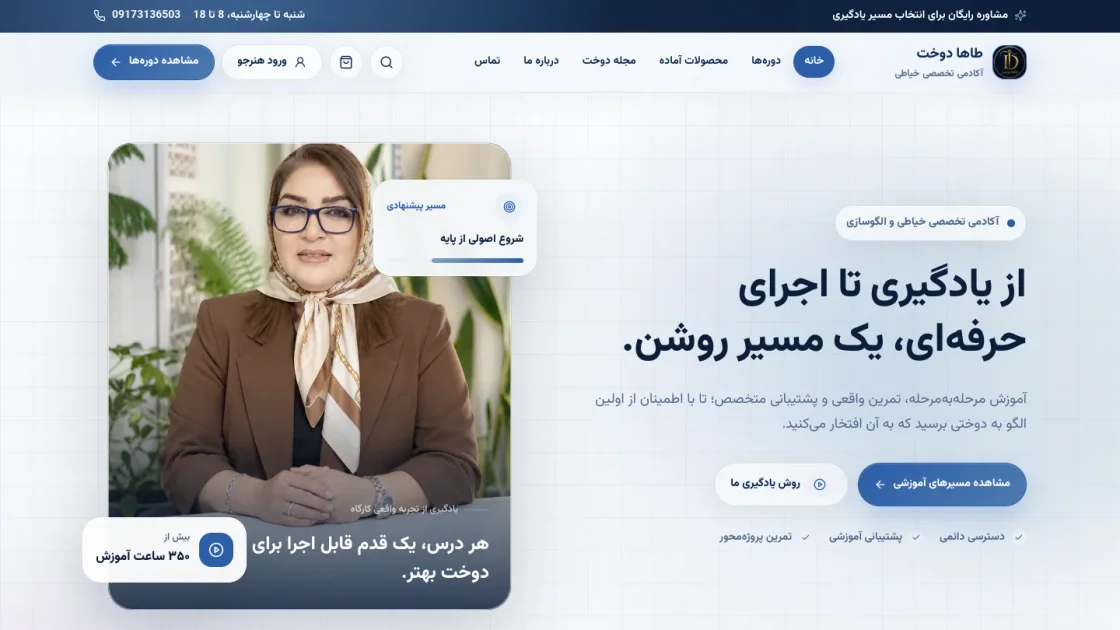
Tahadoukht
A distinct tailoring, sewing, and pattern-making education storefront built on a reusable course-commerce architecture.
Full-Stack Developer